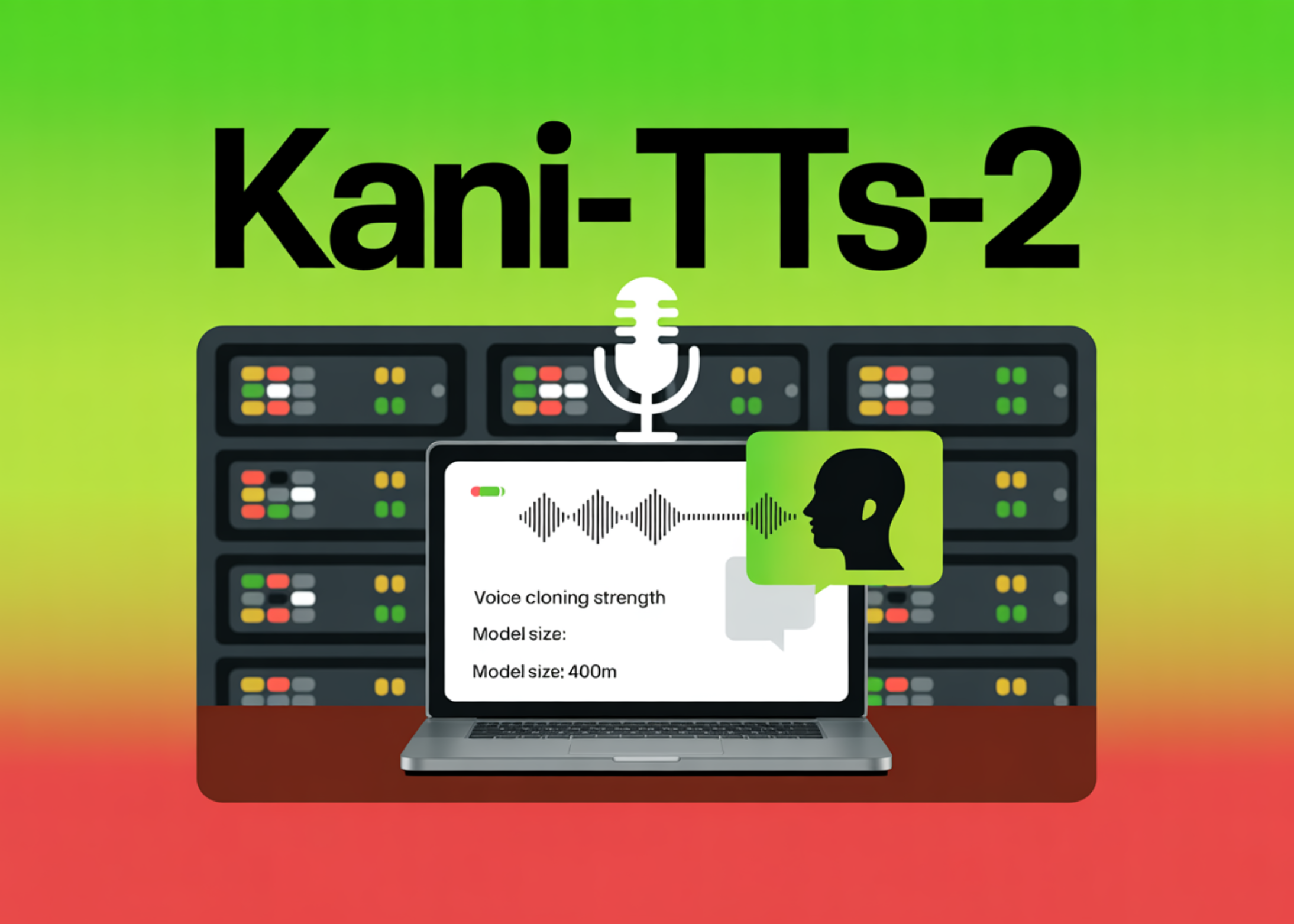


The landscape of generative audio is shifting toward efficiency. A new open-source contender, Kani-TTS-2, has been released by the team at nineninesix.ai. This model marks a departure from heavy, compute-expensive TTS systems. Instead, it treats audio as a language, delivering high-fidelity speech synthesis with a remarkably small footprint.
Kani-TTS-2 offers a lean, high-performance alternative to closed-source APIs. It is currently available on Hugging Face in both English (EN) and Portuguese (PT) versions.
The Architecture: LFM2 and NanoCodec
Kani-TTS-2 follows the ‘Audio-as-Language‘ philosophy. The model does not use traditional mel-spectrogram pipelines. Instead, it converts raw audio into discrete tokens using a neural codec.
The system relies on a two-stage process:

By using this architecture, the model captures human-like prosody—the rhythm and intonation of speech—without the ‘robotic’ artifacts found in older TTS systems.
Efficiency: 10,000 Hours in 6 Hours
The training metrics for Kani-TTS-2 are a masterclass in optimization. The English model was trained on 10,000 hours of high-quality speech data.
While that scale is impressive, the speed of training is the real story. The research team trained the model in only 6 hours using a cluster of 8 NVIDIA H100 GPUs. This proves that massive datasets no longer require weeks of compute time when paired with efficient architectures like LFM2.
Zero-Shot Voice Cloning and Performance
The standout feature for developers is zero-shot voice cloning. Unlike traditional models that require fine-tuning for new voices, Kani-TTS-2 uses speaker embeddings.
- How it works: You provide a short reference audio clip.
- The result: The model extracts the unique characteristics of that voice and applies them to the generated text instantly.
From a deployment perspective, the model is highly accessible:
- Parameter Count: 400M (0.4B) parameters.
- Speed: It features a Real-Time Factor (RTF) of 0.2. This means it can generate 10 seconds of speech in roughly 2 seconds.
- Hardware: It requires only 3GB of VRAM, making it compatible with consumer-grade GPUs like the RTX 3060 or 4050.
- License: Released under the Apache 2.0 license, allowing for commercial use.
Key Takeaways
- Efficient Architecture: The model uses a 400M parameter backbone based on LiquidAI’s LFM2 (350M). This ‘Audio-as-Language’ approach treats speech as discrete tokens, allowing for faster processing and more human-like intonation compared to traditional architectures.
- Rapid Training at Scale: Kani-TTS-2-EN was trained on 10,000 hours of high-quality speech data in just 6 hours using 8 NVIDIA H100 GPUs.
- Instant Zero-Shot Cloning: There is no need for fine-tuning to replicate a specific voice. By providing a short reference audio clip, the model uses speaker embeddings to instantly synthesize text in the target speaker’s voice.
- High Performance on Edge Hardware: With a Real-Time Factor (RTF) of 0.2, the model can generate 10 seconds of audio in approximately 2 seconds. It requires only 3GB of VRAM, making it fully functional on consumer-grade GPUs like the RTX 3060.
- Developer-Friendly Licensing: Released under the Apache 2.0 license, Kani-TTS-2 is ready for commercial integration. It offers a local-first, low-latency alternative to expensive closed-source TTS APIs.
Check out the Model Weight. Also, feel free to follow us on Twitter and don’t forget to join our 100k+ ML SubReddit and Subscribe to our Newsletter. Wait! are you on telegram? now you can join us on telegram as well.
Michal Sutter is a data science professional with a Master of Science in Data Science from the University of Padova. With a solid foundation in statistical analysis, machine learning, and data engineering, Michal excels at transforming complex datasets into actionable insights.