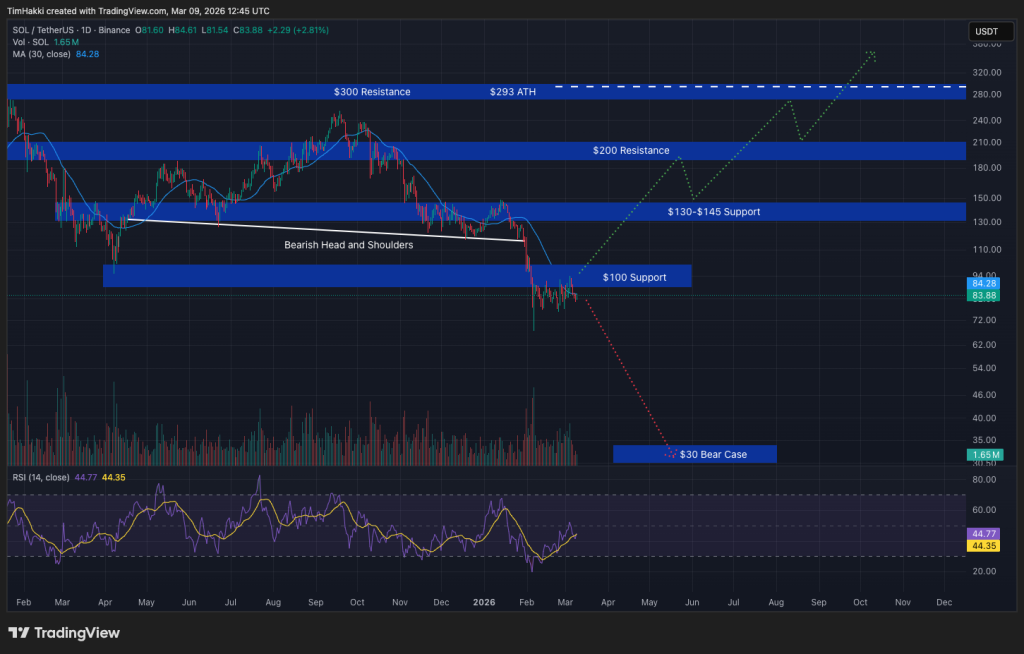


Solana (SOL) ETFs have defied brutal market mechanics since going live in July 2025. While the token’s price collapsed by a little over 57% over the same period, the funds themselves have attracted $1.45 billion in net inflows.
This extreme divergence signals that a “serious investor base” is accumulating heavily even as retail capitulates.
Normally, assets that fall this sharply struggle to attract new liquidity. But Solana ETFs are doing the opposite, absorbing capital at a rate that effectively decouples institutional demand from spot price action. Adjusted for market capitalization, the buying pressure is nearly unprecedented.
To put the numbers in perspective, Solana’s inflow data is arguably stronger than Bitcoin’s when scaled for size.

Bloomberg Intelligence analyst Eric Balchunas notes that if adjusted for the market cap difference, Solana’s $1.45 billion haul is the equivalent of $54 billion in net new flows for Bitcoin, roughly double what Bitcoin ETFs managed at the same stage.
While Bitcoin holds above $68,000 amid strong ETF inflows, Solana’s accumulation during a 50%+ crash highlights a different kind of conviction.
“About as unlucky timing as you’ll ever see,” Balchunas wrote on X regarding the launch timing relative to the price crash. Yet, the funds have not only accumulated capital but retained it.
“They managed to not only accumulate $1.5 billion in flows but also not really give any of it up. Both are really good signs for the future.”
Discover: The best meme coins on Solana
Will SOL Price Catch Up with ETF Volume?
The resilience of these flows suggests the buyer profile is drastically different from the typical retail trader.
According to 13F filings, the majority of Solana ETF holders are institutions, hedge funds, pension funds, and asset managers, who typically operate with multi-year time horizons. They are buying the thesis, not the weekly candle.
As $1.5 billion floods Solana ETFs despite the crash, the data indicates smart money views the $85 range as a deep value zone. If these investors refused to sell during the steep slide from $300, they effectively set a high-conviction floor.
This behavior creates a “diamond hand” dynamic where a significant portion of the floating supply is moving into cold storage custody vehicles.
Balchunas framed the situation clearly: “If we adjust for the size of Solana versus Bitcoin market cap, it’s the equivalent of $54 billion in net new flows.”
For active traders, this metric is a leading indicator. Volume often precedes price, and in this case, custodial volume is screaming bullish divergence even while the chart looks bearish.
Could Institutional Accumulation via Solana ETFs Trigger a Supply Shock?
The broader implication here is a potential supply squeeze. When price drops but custody holdings rise, the asset becomes more illiquid on the sell side.
We are seeing a similar dynamic elsewhere in the market, where Bitcoin is vanishing from exchanges at rates that suggest a looming supply shock.
For Solana, the setup is even more aggressive given the market cap disparity. Investors viewing current prices as a buying opportunity rather than a warning sign have absorbed the selling pressure from the FTX-era unwinds and broader market corrections.
If market sentiment flips neutral or bullish, the lack of liquid supply could force a violent repricing to the upside.
The level to watch is $100. If ETF inflows sustain their current pace, a reclaim of this psychological level could trigger a squeeze against late shorts who are betting on a continued downtrend.
Discover: The best crypto to diversify your portfolio with
The post Solana ETFs Build ‘Serious Investor Base,’ Outpacing Bitcoin in Key Metrics appeared first on Cryptonews.